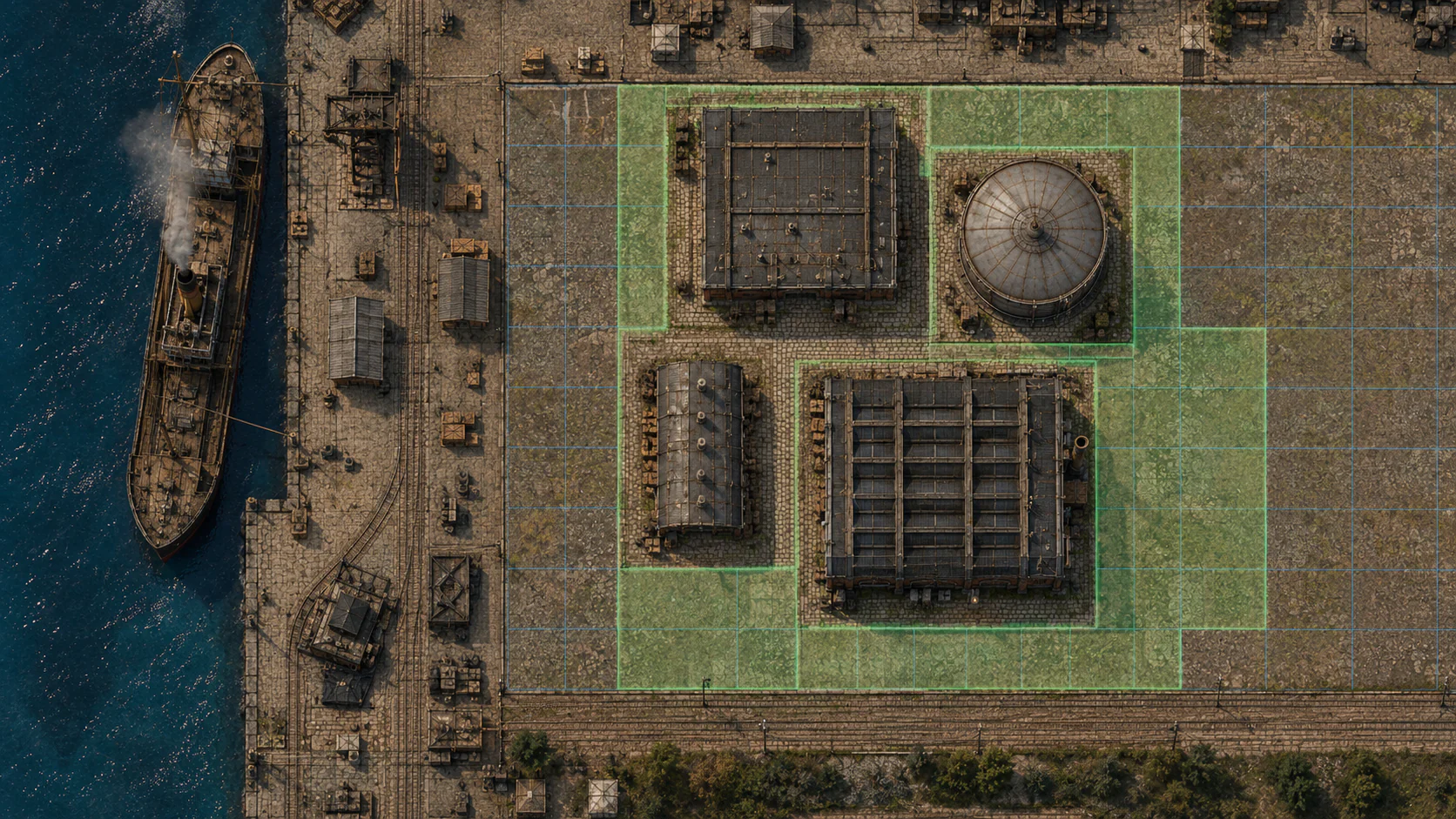
Development of Global Fleet & Trade continues to advance. The land editor is currently emerging as an important new game area intended to expand the economic development of the player's shipping company substantially.
In future, players will not only own ships and operate trading routes, but also acquire their own plots in ports. These areas can then be developed and used economically. This creates the foundation for warehouses, specialist storage facilities, production sites and later industrial plants.
A central element of the new system is the construction grid. Plots are divided into individual cells, making it clear which areas are free, occupied or already owned by a player. Buildings require a specific number of grid cells according to their type and can be constructed only where sufficient space is available.
Examples of planned building classes include:
Small buildings 1×1 or 2×2 cells
Warehouses 3×2 or 4×2 cells
Oil storage 3×3 cells
Production facilities 4×3 cells or larger
Large installations 6×4 cells
The land editor will later be particularly important to the harbour economy. Storage buildings can increase the capacity of a location, while production facilities can process raw materials and create new goods. A simple plot can therefore gradually become a valuable economic site.
Planned facilities include:
Warehouses
Oil storage facilities
Machinery warehouses
Building-material warehouses
Coal-processing facilities
Production facilities
Shipyard and industrial installations
The land editor is therefore an important step towards greater economic depth. Ports should not merely be places for buying and selling goods, but develop into the player's own locations where investment, construction, storage and production take place.
With this system, Global Fleet & Trade continues to grow towards an extensive trading and economic simulation in which not only the fleet matters, but also the intelligent development of the player's infrastructure on land.
Land editor in development: purchase, build on and use plots economically