At the beginning there was no finished game world, only an idea: a maritime economic simulation combining trade, ports, ships and long-term development. Step by step, this idea developed into the Global Fleet & Trade project.
The first months were shaped by many experiments, sketches and technical trials. The initial goal was not to build a finished game immediately, but to discover what direction the project should take. Which historical period fits the game world? How can trade by sea feel credible? What roles should ports, routes, ships, counting houses and markets play? And how can these elements become a system that not only works, but also possesses atmosphere?
There were many open questions in the beginning. Some approaches were tested, discarded and reconsidered. Certain ideas looked good on paper but later failed to provide the intended depth. Other concepts had to be revised several times because they were technically too complex, unclear in gameplay or not yet visually coherent.
These obstacles gradually produced a clearer picture. Global Fleet & Trade would not be a fast action experience, but a calm, strategic trading world. Players would not simply dispatch ships, but build a shipping company, acquire port rights, establish counting houses, move goods and make long-term economic decisions.
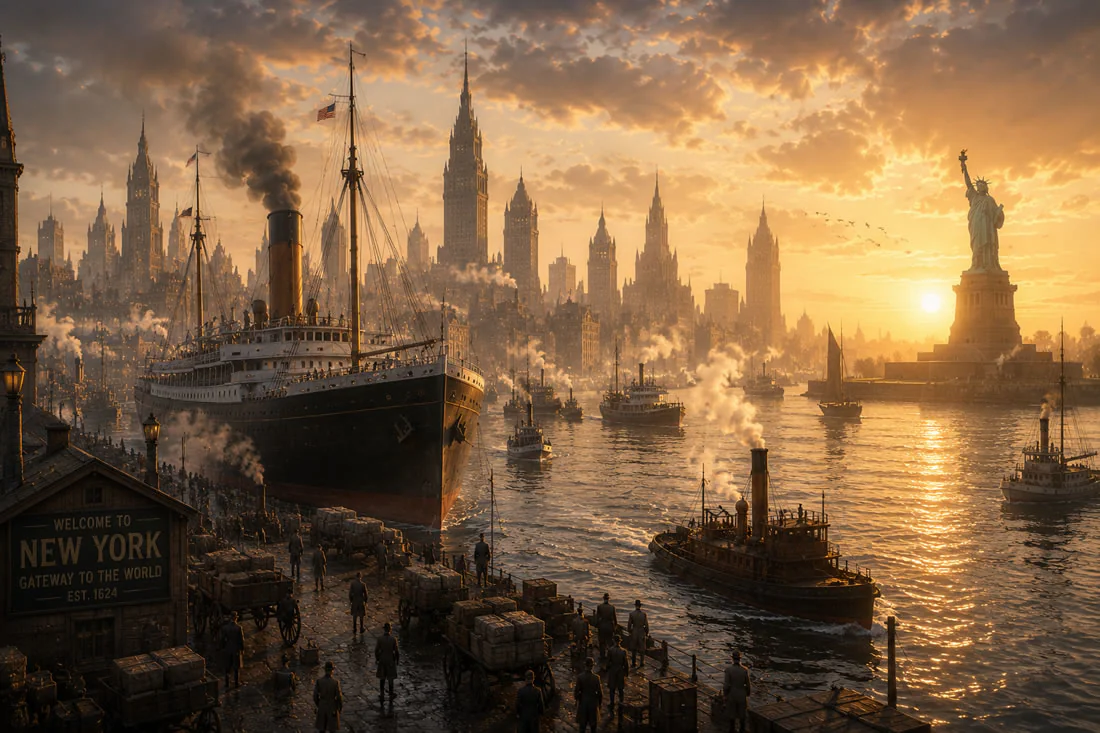
The historical setting also became increasingly important during this phase. The period between 1880 and 1920 offered exactly the right combination of traditional seafaring, industrialisation, steamships and international trade. It created a foundation with ample scope for both gameplay and atmosphere.
The real starting signal came when individual ideas became one connected project. Loose thoughts turned into initial rules, tables, interfaces and game areas. Ports gained meaning, ships became central gameplay elements and the world map became more than a background image.
This early phase was not always straightforward. Many parts had to be rebuilt several times. Yet that phase was decisive because it shaped the project. The many experiments, detours and problems helped define Global Fleet & Trade more clearly.
Today, this starting point forms the basis for everything that followed: the maritime design, trading system, port logic, world map, routes and visible ship movements. An idea has become a long-term project with its own direction, its own atmosphere and a growing game world.
The starting signal for Global Fleet & Trade