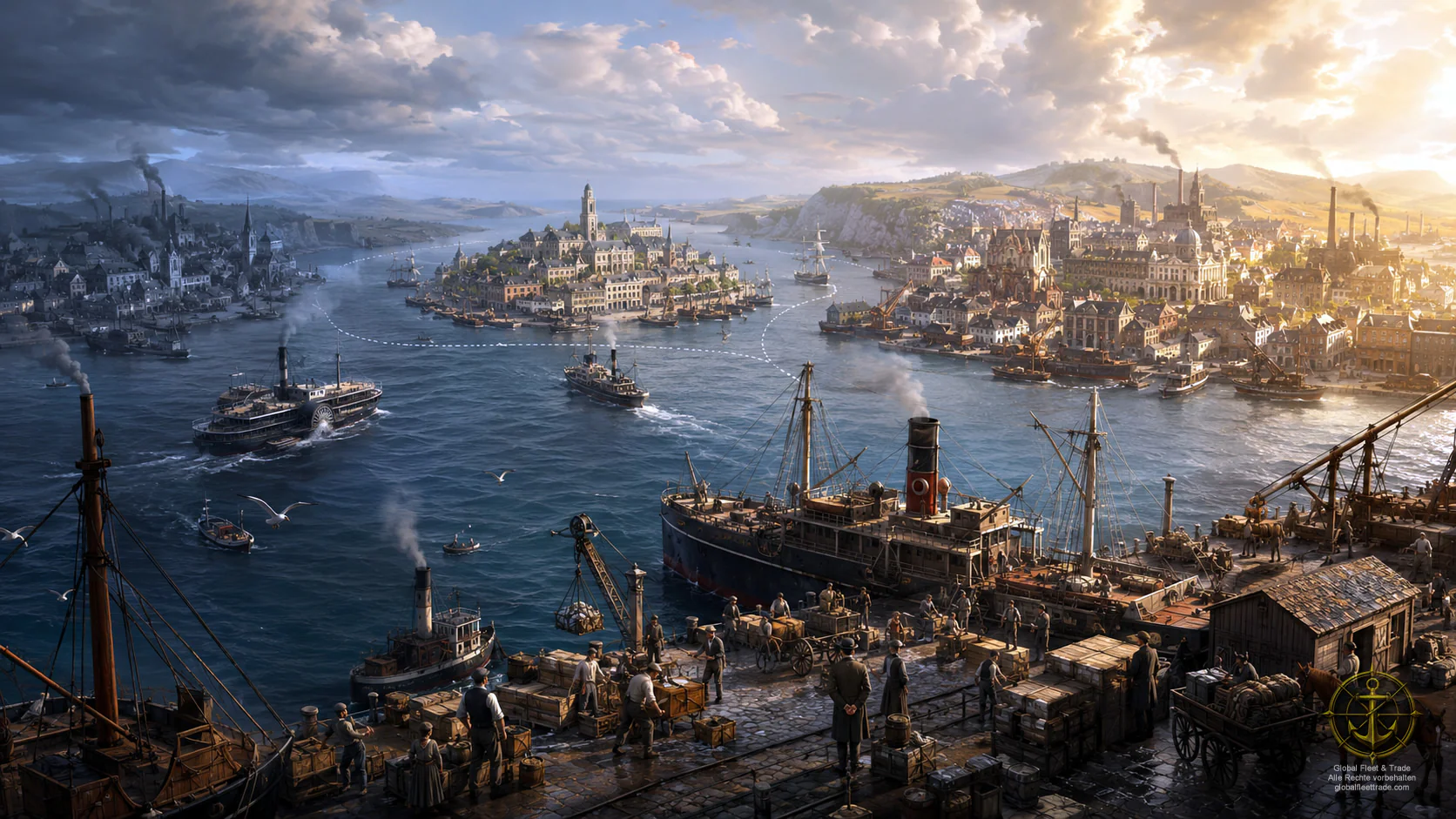
Global Fleet & Trade has reached another important milestone.
The world no longer responds exclusively to production, consumption and trade. The populations of its cities are increasingly becoming part of economic development as well.
A well-supplied and stable city can grow and attract new residents. A city suffering from persistent shortages or economic weakness can instead lose population. The system does not examine only the overall change: inward migration, outward migration and the resulting net development are evaluated separately for each city.
For the first time, this makes the real effect of a city's economic situation on its population visible.
The entire world in view
A particularly important advance is the new complete evaluation of the game world.
Instead of examining only individual cities or isolated shortage situations, all cities can now be observed together over longer periods. The duration of the simulation can be selected freely, ranging from short checks to multi-year world runs.
Results are summarised by year. This reveals whether developments are merely short-term effects or persist over a long period.
Every city is classified automatically into one of three groups:
- growing
- stable
- declining
Unusual or especially striking developments are marked as well. Cities with heavy losses, exceptional growth or problematic supply patterns can therefore be identified quickly and examined in greater detail.
Not only what happens, but why
A population figure alone is not sufficient for a believable world simulation.
The new evaluation therefore also shows which causes lie behind a city's development. Supply, economic stability, recurring shortages and further influences can be considered together.
The system does not merely show that a city is declining. It also makes clear why residents are leaving.
At the same time, this creates the foundation for a world in which cities do not remain unchanged forever. Their development depends on how well their population is supplied, how stable their economy remains and which changes are produced by trade.
Trade gains long-term consequences
This development is also highly significant for later player actions.
Trade should not produce only short-term profits. By ensuring good supply, players can help stabilise a city or support its growth.
At the same time, ruthless trade can have long-term consequences. If important goods are removed from a city continuously or shortages are deliberately worsened, this can harm the economic and social development of the location.
The decision of where and in which goods to trade will therefore become substantially more strategic.
Pre-Alpha Stable reached
The Global Fleet & Trade economy simulation core is classified as Pre-Alpha Stable at this stage.
This does not mean that every detail has already reached final balance. It does mean, however, that the fundamental processes are stable enough to run longer world simulations, compare developments and investigate problematic cities specifically.
Production, consumption, supply, economic development and population movements are increasingly growing into one connected system.
The world is no longer merely alive.
It is beginning to change itself.
The world begins to develop on its own