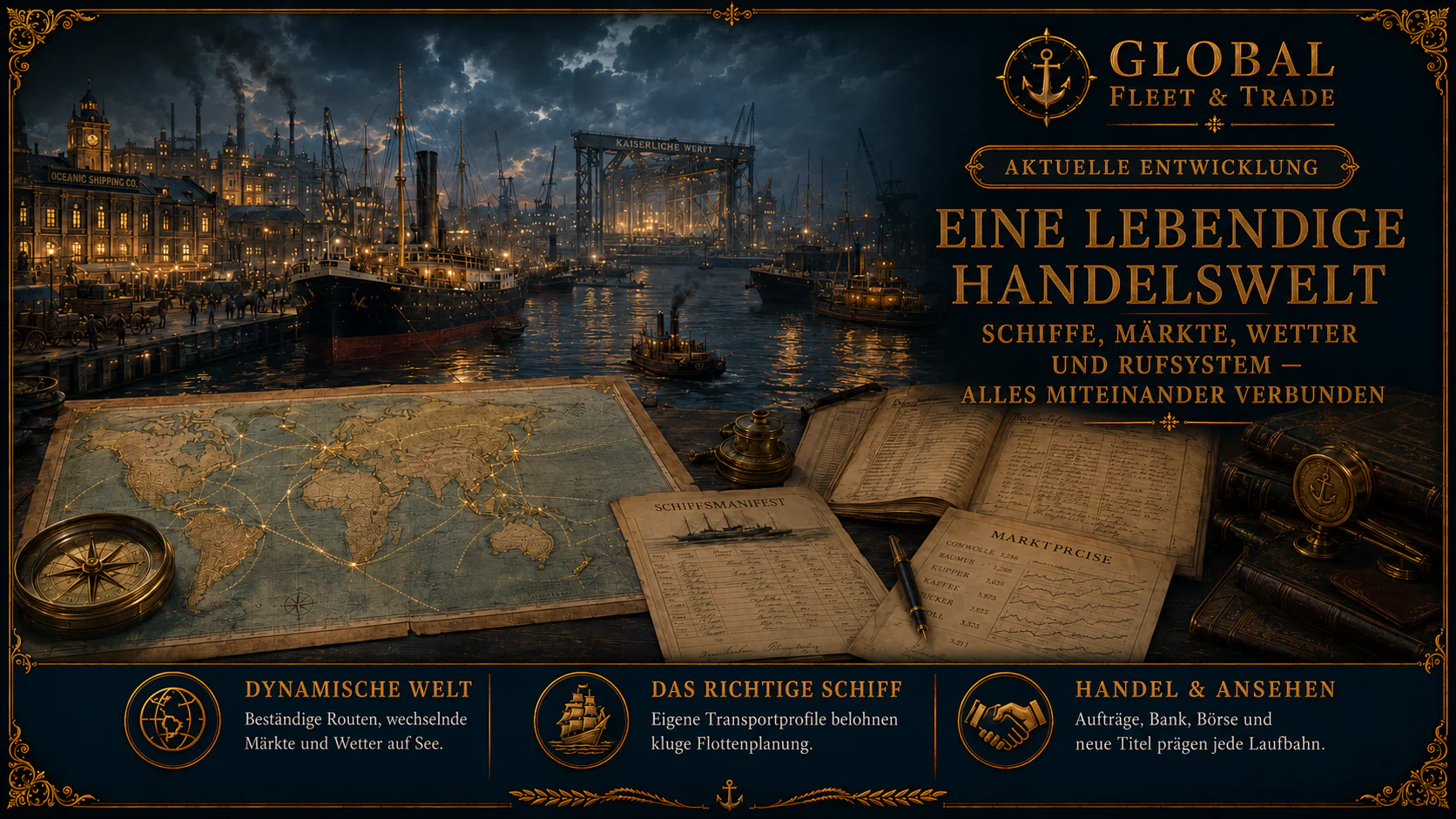
The new market system connects 25 port cities with 20 different commodities. Each port has its own exports, import demands and neutral goods. Production, consumption, inventories and prices continue to develop over time.
Market fees, regional price differences and changing supplies make careful planning more important than ever. Successful shipowners must observe the markets, compare prices and trade at the right moment.
Redesigned Route System
Ships can be selected, loaded and dispatched directly from their current port. Several actions are available for the cargo upon arrival:
sell it automatically at the destination
store it in the local trading office
keep it aboard the ship
Departure port, destination, arrival time, remaining journey time and cargo are clearly displayed. Travelling ships move across the world map based on actual journey progress and continue sailing even when no player is viewing the map.
A Living World Map and Dynamic Weather
The world map has been extensively expanded. Ports, city names, ships, sea routes and personal markers can be selected directly. Price information appears depending on the zoom level, while travelling ships remain visible with their route and current position.
Different cloud and weather systems now move across the oceans. If a ship enters one of these areas during a voyage, its speed, condition, journey time or cargo may be affected. Each weather effect can only be triggered once per route.
Fleet, Logbook and Trading Offices
The new fleet overview displays active ships with their current status, location, destination, cargo, condition and expected arrival time. Ships offered on the second-hand market no longer appear as part of the active fleet.
The logbook records important events involving trade, ships, routes, trading offices, markets and system messages. Several filters help maintain a clear overview as a shipping company continues to grow.
Trading offices form an important part of a company’s commercial network. Newly established offices begin with 25 tons of storage capacity and can later be expanded. Regular merchandise and special contract cargo are managed separately.
Contracts and Tavern Life
Rumours, stories and delivery contracts await players in the taverns of the port cities. Different characters offer changing information and opportunities each day.
Up to two rumours or stories can be acquired per day. Players may also buy a round of drinks once each day, improving their reputation.
Delivery contracts have different sizes, deadlines and rewards. Contract cargo is stored separately and must be delivered to the specified destination before the deadline. Global emergency contracts may also appear during exceptional economic situations.
New and Second-Hand Ships
The shipyard has been significantly expanded. Shipowners can order new vessels, purchase second-hand ships, sell vessels from their own fleet, carry out repairs, install equipment and rename their ships.
New vessels are no longer available immediately after purchase. Construction times now depend on the ship type and class. Small coastal ships can be completed relatively quickly, while the largest ocean-going vessels may require several days.
The reputation system determines which ship classes may be purchased. The Small Coastal Steamer remains permanently available as a basic starter vessel.
Individual Transport Profiles
Every ship type receives its own transport profile. This determines how suitable the vessel is for six different cargo categories.
A tanker, for example, reaches its full capacity when carrying oil and liquid bulk cargo, but performs significantly worse with refrigerated or sensitive general cargo. Refrigerated ships, bulk carriers, general cargo vessels and mixed freighters each possess their own strengths and weaknesses.
These transport factors directly affect the ship’s usable cargo capacity. Size and speed are therefore no longer the only important values—the right vessel must also be chosen for the intended cargo.
Ship Upgrades and Condition
Machinery, cargo holds and navigation systems can be installed as permanent upgrades. These improvements directly affect the corresponding ship values and are included throughout the relevant overviews.
Technical condition also remains important. Long voyages cause wear, while repairs require both time and money. Shipowners who neglect their fleets must expect reduced performance and higher future costs.
Reputation, Titles and Rankings
The new reputation system accompanies the entire development of a shipping company. Successful contracts, trading activity, travelled nautical miles, new port rights, trading offices and confirmed rumours all increase a shipowner’s reputation.
Numerous titles can be earned, ranging from Unknown Merchant to Shipowner, Great Shipowner, Trading Magnate and finally World Market Leader. A higher reputation gradually unlocks larger and more powerful vessels.
A ranking system also allows players to compare the development of their shipping companies.
Banking and the Stock Exchange
Every shipping company now has its own bank account. Income and expenses from trading, ship purchases, repairs, trading offices, tavern visits, contracts and securities transactions are recorded as traceable account movements.
Shares in different companies can be purchased through the stock exchange. These include shipyards, trading companies, coal companies, machinery works, port operators, warehouse companies, refrigerated transport companies and commercial banks.
Share prices are influenced by events within the game world. Ship construction, repairs, trading volumes, demand for raw materials and port activity can all affect individual companies.
Greater Security and a Consistent Design
Account security has been expanded with optional two-factor authentication. It protects the login process as well as particularly important financial actions.
Many areas have also received a more consistent visual design. Dialogues, buttons, spacing and overviews have been revised so that the shipyard, tavern, stock exchange, contracts, bank and other game pages now fit together much more effectively.
Global Fleet & Trade is increasingly evolving from a collection of individual features into a connected and persistent trading world. Markets, ports, ships, contracts, weather, reputation, banking and the stock exchange are becoming more closely linked.
The foundations are in place—now the world is truly beginning to come alive.
Global Fleet & Trade Is Growing into a Living Trading World