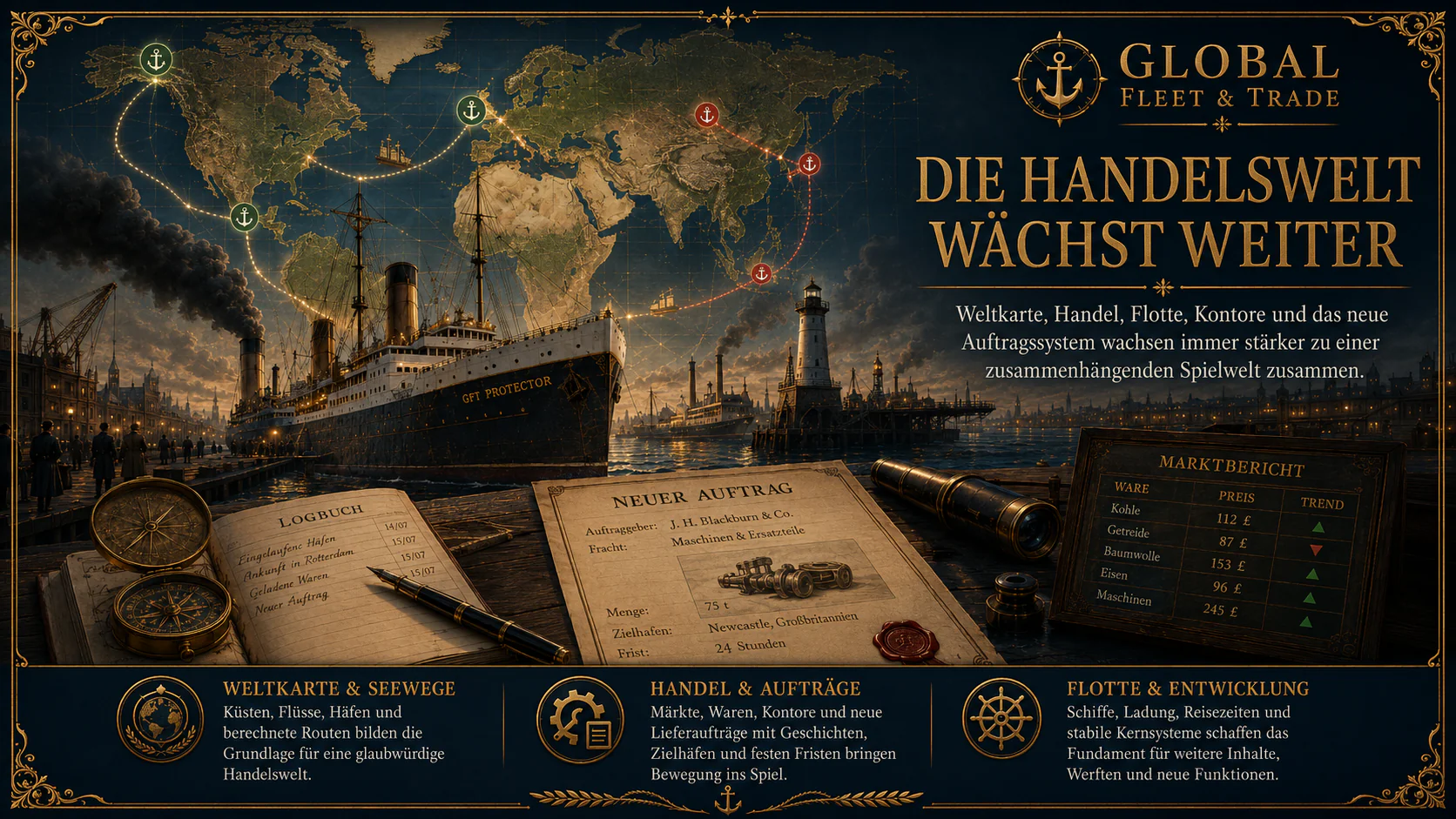
The development of Global Fleet & Trade has reached an important stage. What once consisted of separate functions is gradually becoming a connected world of trade and shipping in which vessels, goods, ports, offices, and contracts directly interact with one another.
One of the major milestones is the new world map. Coastlines, rivers, ports, and sea routes form the foundation for navigation. Ships follow calculated routes, move visibly across the map, and reach their destinations according to the actual duration of the voyage.
The trading system has also made significant progress. Numerous ports now offer their own range of goods, individual levels of demand, and varying prices. Goods can be purchased, stored in offices, loaded onto ships, and transported to other trading locations.
Ship capacity, available storage space, travel times, market prices, and potential profits all play an important role. Every voyage must be planned carefully, as not every commodity is equally valuable or in demand at every port.
The fleet overview displays the condition, location, cargo, and current assignment of each vessel. The logbook also records important events such as purchases, sales, departures, arrivals, and changes within the company.
A major current focus is the new contract system. Delivery contracts include their own stories, clients, cargo images, destination ports, quantities, and fixed deadlines. This is intended to make contracts feel like small events within the game world rather than simple transport instructions.
Once a contract has been accepted, the required cargo must be loaded and delivered to the specified destination on time. Different contract sizes create varying demands in terms of time, cargo space, and planning.
Special emergency contracts issued by cities remain a separate system. They can arise from economic shortages and are clearly distinguished from regular delivery contracts.
The presentation is also being continuously improved. Buttons, input fields, information panels, and overviews are being brought into a more consistent visual style. Goods, ships, cities, and clients are also represented by their own individual artwork.
The next steps include additional trade goods, more contracts, the expansion of shipyards, and new features for purchasing, repairing, and eventually upgrading ships.
Global Fleet & Trade is still in an early stage of development. However, the foundations of a living trading world are now in place and will continue to be filled with new systems and content step by step.
Global Fleet & Trade – The Trading World Continues to Grow