
GLOBAL FLEET & TRADE · HANDBOOK
Large Bulk Carrier
High-volume bulk transport. This page explains values, cargo profiles, approvals, intended use and limitations of this vessel type.
At a Glance
- Vessel class 5 with 700 t nominal capacity.
- Speed: 9.0 kn.
- Required operator reputation: 1,250 points.
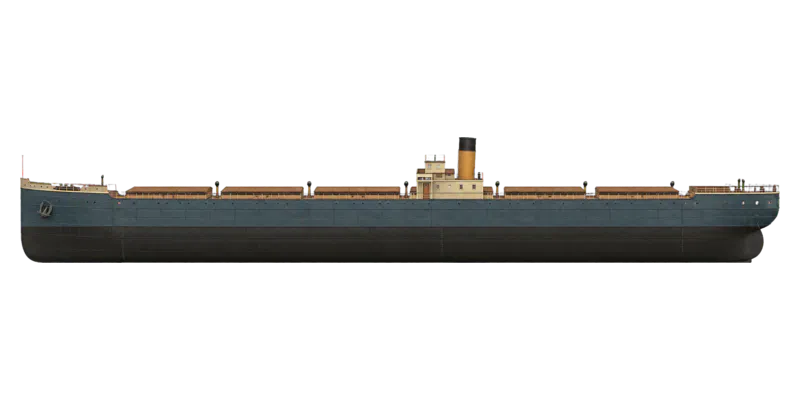
Technical Base Data
These values apply to the vessel type in new-build condition. An individual vessel may differ because of condition and later upgrades.
Intended Use
High-volume bulk transport: According to the vessel catalogue, this type is especially suited to Grain, coal, iron, salt, sugar and copper. Assign the good to its cargo group and then check the transport profile. Technical suitability never guarantees profit; price, distance, storage and destination market must be assessed separately. good · transport profile
Cargo Profile of This Vessel
The percentage determines how much nominal capacity can practically be used for a cargo group. At 100%, the full nominal capacity is available. A lower value reduces maximum cargo. See Transport Profiles and Cargo Approvals for the complete system.
| Cargo Group | Profile Effect | Maximum Usable | Meaning |
|---|---|---|---|
| Agricultural bulk | 100 % | 700 t | Loose or large-volume agricultural products. |
| Industrial bulk | 100 % | 700 t | Loose or large-volume industrial raw materials. |
| General cargo | 60 % | 420 t | Packaged goods that can be handled individually. |
| Heavy and oversized cargo | 90 % | 630 t | Heavy or oversized cargo with special space requirements. |
| Refrigerated cargo | 55 % | 385 t | Perishable goods requiring suitable refrigeration. |
| Oil / liquid bulk | 65 % | 455 t | Liquid bulk goods and suitable container cargo. |
Technical Cargo Approvals
A good profile is not enough if technical approval is missing. Approved means the vessel type satisfies that requirement; not approved prevents loading goods that require it.
How to Check This Type Before Use
- Identify the good and its cargo group.
- Check the required technical approval.
- Read the actually usable tonnes in the profile table.
- Compare speed and distance to assess travel time.
- Check the condition of the individual vessel.
- Assess market, stock and destination separately; technical suitability is no profit guarantee.